
Sales tax payable review
Reconciling the GL sales tax liability to the POS calculation, backing out marketplace-facilitator tax, and the RCY prepayment nuance.
Reconcile the GL sales tax liability to the sales-tax-collected calculation derived from the POS/sales entry.
Source: Rackson_RRS_RCY_Review_Process.docx sections 9 and 27.5.
Marketplace-facilitator tax is the most common source of an apparent variance. Delivery platforms collect and remit sales tax directly to the state on the operator's behalf — that must be backed out of Rackson's own liability calculation.
The core distinction
Sales tax collected per the POS is not always the same figure used when the return is filed. Understand the difference before explaining any store-level or account-level variance:
| Figure | What it is |
|---|---|
| Tax collected per POS | What we calculated we should have collected |
| Tax remitted per return | What we actually paid, per the filed return |
A variance between them reflects normal over/under-collection at store level relative to what the return says — not necessarily an error.
Step-by-step checklist
For the period.
Before any marketplace-facilitator adjustment.
The portion delivery platforms have already collected and remitted directly.
If they don't match, locate the relevant tab/cell in the sales tax workbook and identify which store(s) are driving the difference.
Confirm whether it is a facilitator-timing item or a true posting error before adjusting.
For any variance above the working threshold, then mark the item reviewed.
Illustrative example. A roughly $400 variance was identified in one period and traced by locating the relevant tab/cell in the workbook and confirming which stores were driving the difference, before concluding whether it was a marketplace-facilitator timing item or a true posting error. This remains an open item — see Open items.
RCY (Dave's) — sales and cap tax
Owner: Betsy
The RCY version of this reconciliation can get more convoluted than the RRS version because of the volume of prepayments involved.
There are prepayments affecting the prior month and separate prepayments affecting the upcoming month. These must be kept visually distinct in the workbook — colour-coded — rather than commingled.
A given month's sales tax activity is not always fully paid by the time the books close for that month. Rather than trying to isolate only the truly outstanding portion, the practical approach is:
Don't pre-judge which pieces are prepayments.
As each payment is confirmed.
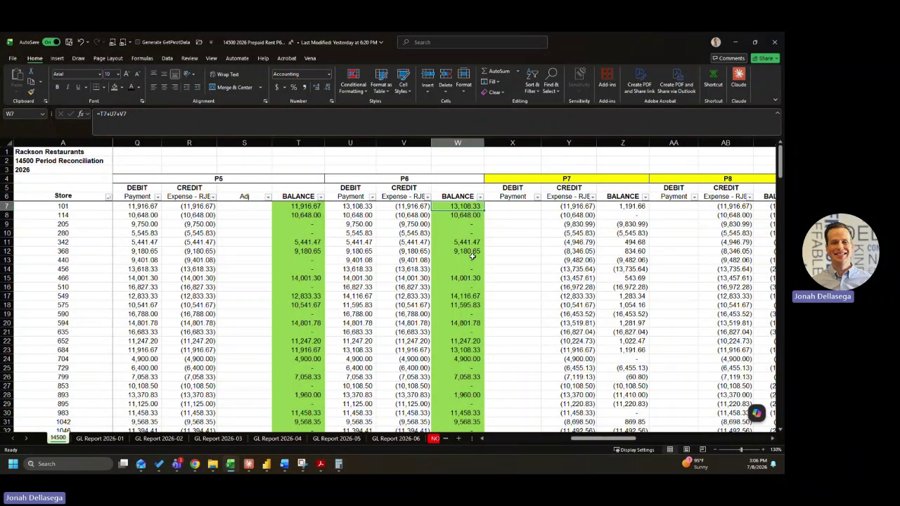
On the RCY workbook, the sales tax collected columns represent what should theoretically be owed based on the POS/sales entry calculation, while the payments columns represent what was actually paid based on the filed return. These two figures are not calculated the same way — a variance between them reflects normal store-level over/under-collection, not necessarily an error.
Sales tax reconciliation is handled outside the core RRS/RCY balance sheet team — Betsy owns it. On the close checklist it is a WD6 task, distinct from the Ohio CAT Tax accrual which lands on WD2.
Related
- RRS taxes and royalties workpapers — the 22200 and 22250 preparer steps across five states
- Delivery service reconciliation — where the facilitator adjustment also appears
- NYC Commercial Rent Tax — the open multi-state tax question