
Other assets and small schedules
Security deposits, franchise fees and financing costs, rebates receivable, payroll card liability, the legacy seller holdback, miscellaneous payables, ERTC, and deferred revenue.
The schedules that are individually small but collectively account for a meaningful share of review time — plus the two client-tracked balances that carry real exposure.
Source: Rackson_RRS_RCY_Review_Process.docx sections 13, 14, 15, 16, 18, 40, and 43.
Timing benchmarks
For planning a first solo close. Treat these as rough orientation, not a service-level commitment.
| Schedule | Approximate time |
|---|---|
| Rebates receivable (GL 12700 & 12730) | ~20 minutes |
| Rebate expense schedule | Quicker than the receivable schedule |
| Security deposits (GL 18100) | ~10 minutes |
| Change fund (10800) / Office petty cash (11000) | Fastest items on the list — usually no activity |
| ERTC tracking (GL 19999) | Effectively none most periods — only touched annually |
Security deposits (GL 18100)
Primarily a completeness and existence check. Monitor for any deposits that may need to be written off or reclassified as a location closes or a lease changes.
Confirm any change is explained by a new lease, a closed location, or a client-flagged item.
To confirm whether the deposit should be written off or reclassified.
Record any concerns from Caitlin directly on the schedule for tracking.
Caitlin is generally proactive here, so this account has historically required little independent digging. It is still reviewed every period — these balances are relatively young (the current population hasn't been through a full lease cycle) so it isn't yet clear how substantial future write-offs might be.
Franchise fees, deferred financing costs, and franchise agreement amortization
All three are client-provided (Mike). PBI maintains and applies the schedules without independently recalculating them.
| Item | Notes |
|---|---|
| Franchise fees / acquisition "bridge" items | Franchise fees recognized on the balance sheet in connection with prior store acquisitions. PBI maintains supporting documentation for each store added through acquisition. Amortization schedules come from Mike and are updated whenever he sends a revision. |
| Deferred financing costs | Monthly amortization schedule provided by Mike. A ~15-cent rounding difference has been noted historically and is not a concern. |
| Franchise agreement amortization | Also client-provided; typically set at the start of the year with updates only as needed if terms change. |
Step-by-step checklist
For any of the three items this period. If not, roll forward the existing schedule.
For each schedule.
For franchise fees tied to an acquisition, confirm supporting documentation exists for any store added during the period.
E.g. the historical ~15-cent difference on deferred financing costs.
Rebates receivable (GL 12700 & 12730)
Two accounts, one schedule. Rebates Receivable spans both GL 12700 and 12730 on a single workbook — don't assume one account number is the whole schedule.
The schedule tracks which rebates are expected, when they're expected to arrive, and which period(s) they relate to. Each rebate is tagged with a reason/category so it's clear why it's on the books.
Recognition philosophy: PBI takes a conservative approach on timing — recognizing rebates when reasonably certain rather than the moment they're announced — which the team believes is the more defensible position for the client group as a whole.
Whose schedule governs: Caitlin maintains her own version and sends updates. PBI's role is to make sure the RJEs tie out to her schedule and stay consistent with it, not to independently rebuild her numbers. PBI can and should challenge or ask questions about her numbers, but her file is treated as the support.
The PTM rebate — the riskiest line on this schedule
One recurring rebate — from a preventive-maintenance (PTM) vendor that services all stores on a roughly six-month cycle — is booked in total but also broken out by location on its own tab, because the amounts per store are small (roughly $600 per six-month cycle per location) and inconsistent invoice-to-invoice.
This is a separate program from the Coke/RSI rebate accrual that appears on the close checklist — don't conflate the two when reconciling.
Open item. There is an open conversation with Mike about simply writing this PTM rebate off to expense going forward rather than tracking it as a receivable, given the small dollar amounts relative to the tracking effort. Not finalized — confirm current treatment before assuming it's been changed.
Additional watch-out. Rebates booked with no activity for an extended period, or any rebate where the underlying invoice amount looks materially different from prior periods, deserve a closer look before rolling the schedule forward unchanged. One review flagged a roughly $30,000 rebate as the single largest exposure item on the schedule.
General rebate review points
The rebate amount is an estimate, not a final figure, developed collaboratively with the client as a starting point. Treat the recorded amount as a reasonable estimate that will be trued up as final information becomes available, rather than expecting it to tie precisely each period.
Developed jointly with the client.
For reasonableness.
And note the true-up on the schedule.
Payroll card liability
This liability should net to zero across all locations in aggregate.
Historically, RRS has tended to show more location-level variances here than other account types. The standard practice is to true individual locations out against each other so the account nets to zero, rather than leaving offsetting location-level balances unresolved.
Behind the payroll card liability balance.
If not, identify which location(s) are driving the imbalance.
And document the correction.
Legacy seller holdback ("two-to-seller")
A holdback balance dating back to the prior year, related to a prior acquisition, remains outstanding — and is a fairly substantial amount of money.
- The seller has been slow to resolve it and has cited unspecified items — potentially repairs, maintenance, or similar — that they intend to net against the balance before releasing it.
- It is unclear whether this will fully resolve by year end. The client has made efforts but does not yet have a firm answer from the seller.
No PBI action is pending absent further information from the client. Simply continue to monitor each period for movement or resolution.
Or note any movement since the prior period.
Regarding resolution or offset items.
If no update is available.
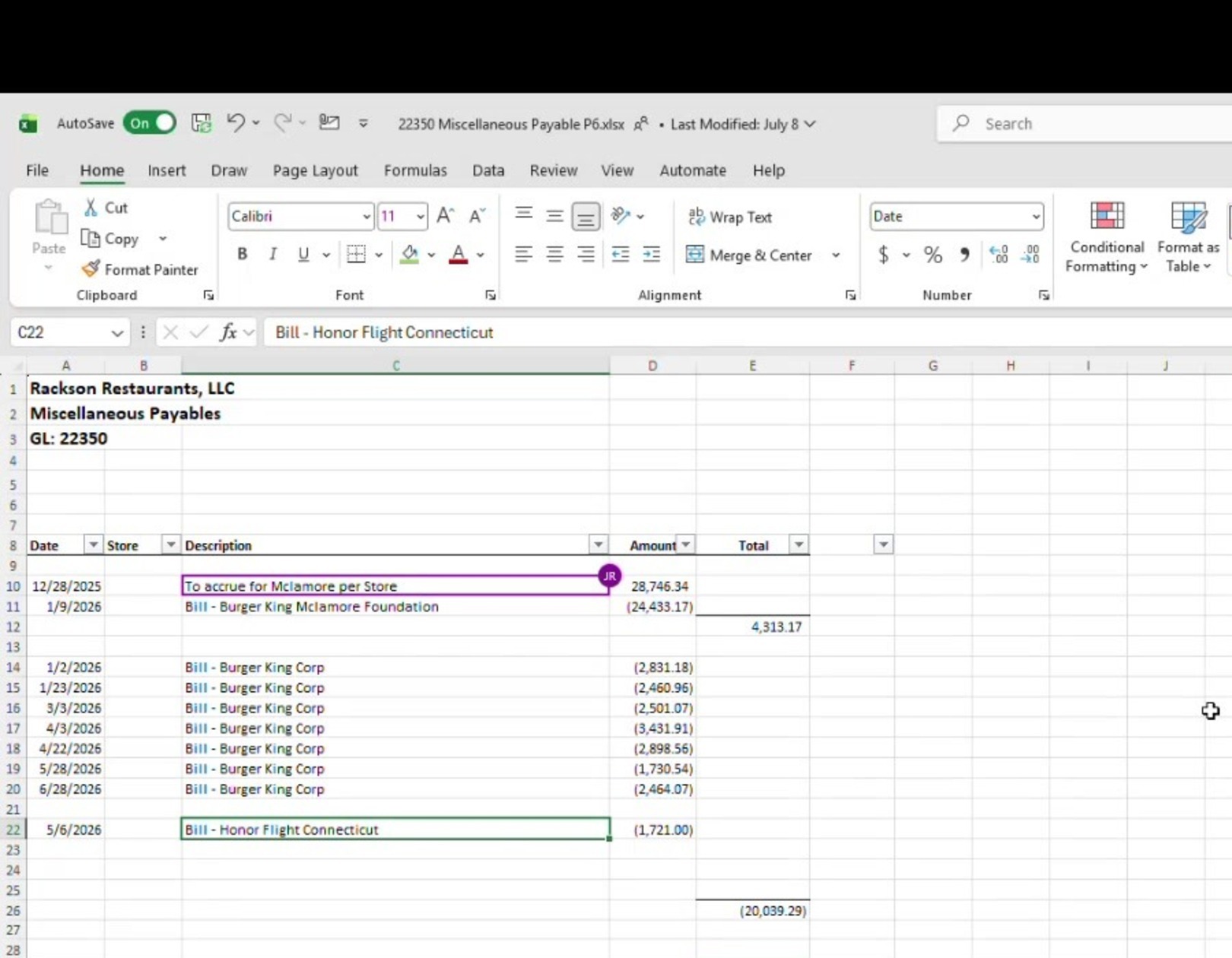
Miscellaneous payable (GL 22350)
File: 22350 Miscellaneous Payable P[n].xlsx
Tracks donations received on the client's behalf — largely through Burger King Corp — and paid back out to the intended charitable recipient.
What the detail actually looks like. Line items include an accrual ("To accrue for Mclamore per Store") and offsetting bills to the Burger King McLamore Foundation and Honor Flight Connecticut — store-level customer/franchise donation collections flowing through this account until remitted to the named charity. Expect charity names rather than vendor names in the detail.
Known duplication — not a problem to fix. Mike's team also tracks a version of this, so there is some duplication by design. Don't spend a lot of time reconciling the two unless something has been sitting on the schedule for an unusually long time — in that case, follow up with Mike directly.
ERTC tracking (GL 19999)
This is the Employee Retention Tax Credit tracking schedule — a COVID-era employer payroll tax credit, not a generic "RTC" line. The account is literally named 19999 - Rackson ERTC Tracking in the balance sheet folder. Use the correct term when searching for it or discussing it with the team.
- Cadence: stays flat for almost the entire year — only updated once annually, when the ERTC-related revenue recognition adjustment comes in.
- Source of the adjustment: the client's auditors send it. PBI's job is to book/adjust the schedule to match what the auditors provide, not to independently recalculate the ERTC recognition.
Deferred revenue (GL 27960)
RRS Deferred Revenue is made up primarily of:
- Tenant improvement allowances the client has received from landlords, amortized over the applicable lease term.
- Franchise agreement incentives — where the client received a credit that gets recognized/amortized over time rather than immediately.
Caitlin also tracks a version of this on the client side. When the two don't agree, that has historically been resolved by following up directly with Mike rather than assuming PBI's schedule is correct by default.
Current portion of long-term debt (GL 27910)
A reclass off the note payable/debt schedules. Confirm the current-portion split is refreshed each period as balances amortize, rather than left at a prior period's static split. See Debt and notes.
Related
- RRS fixed and intangible assets workpapers — the 18100, 17900/17100, 17910/17600, 17920/17200, 17930/17500, and 19999 preparer steps
- RRS receivables workpapers — the 12700/12730 Coke and RSI rebate accrual, and 12850 paycards
- RRS taxes and royalties workpapers — the 22350 preparer steps