
Close checklist and role assignments
Where the close checklist lives, its columns and structure, the representative task list by workday, and the running mid-period notes list.
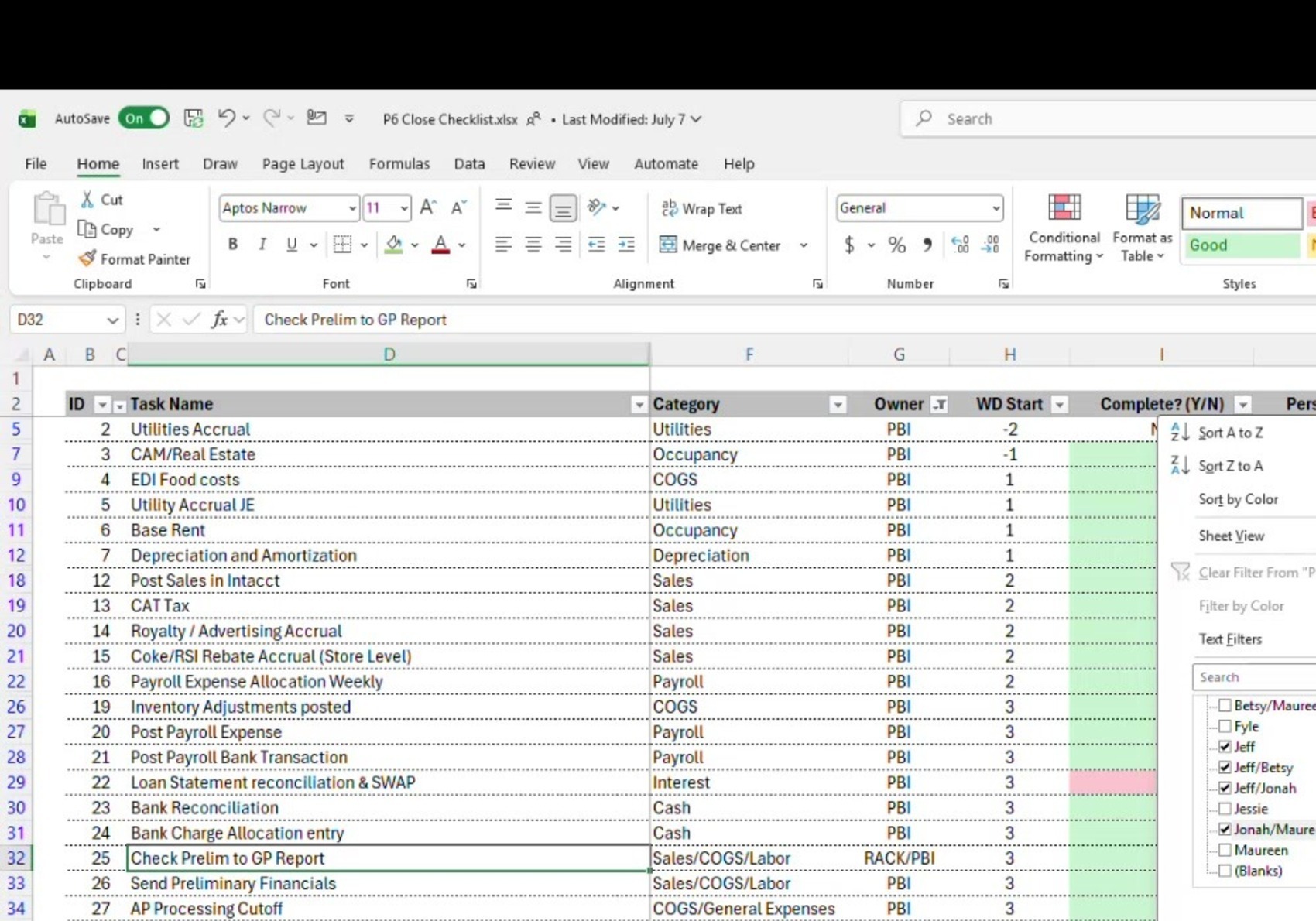
File: P[n] Close Checklist.xlsx — the period number changes each cycle.
Source: Rackson_RRS_RCY_Review_Process.docx sections 47 and 50.
Where the checklist lives
It's a shared location specifically so the wider team — not just the two people who have historically owned this engagement — can access and update it going forward.
Recommended starting point for a new reviewer. If you're new to the engagement, this is the best place to build your own understanding of "what journal entries actually get booked each month," before trying to memorize the balance sheet sections of the review documentation from scratch.
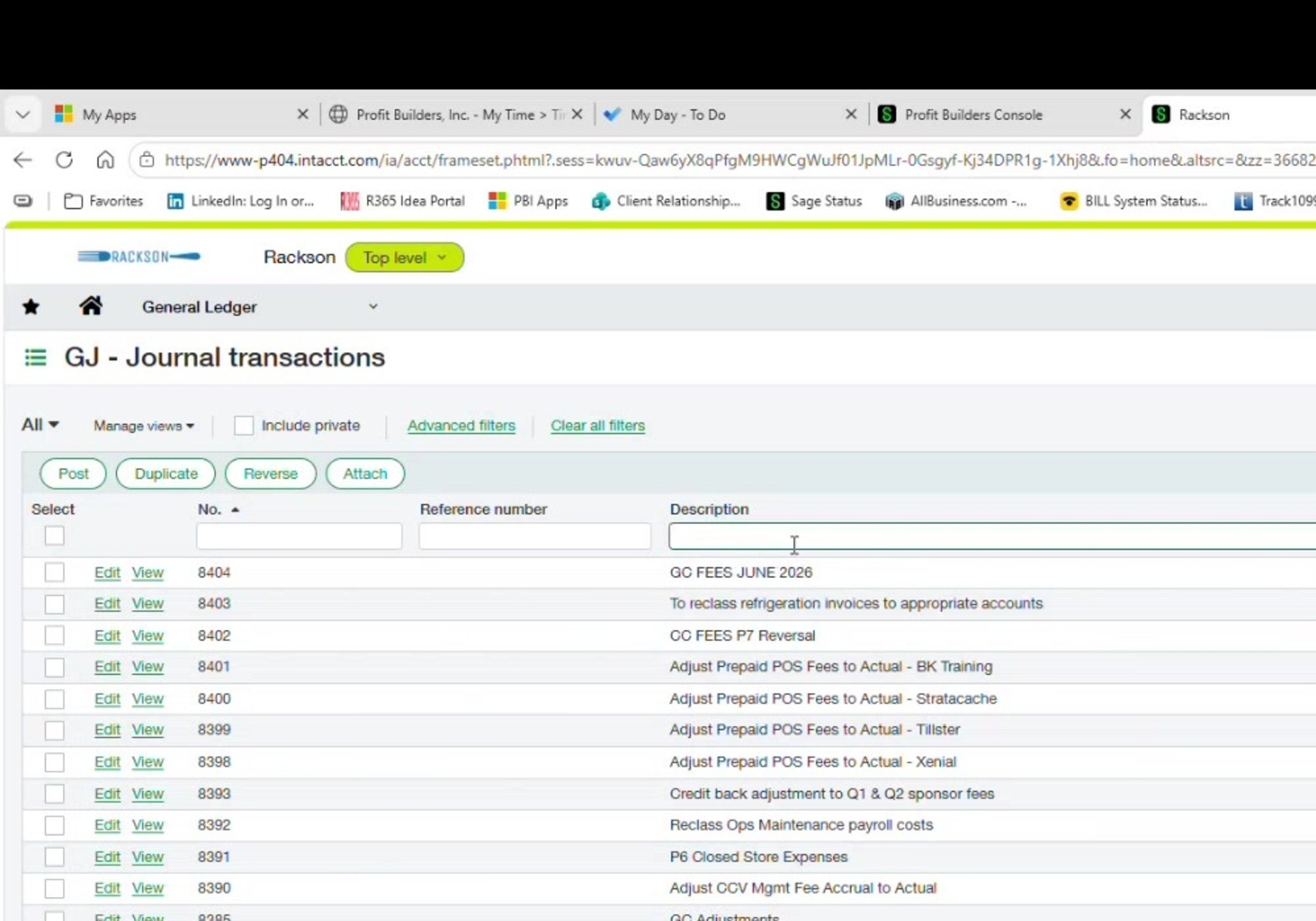
Real entry descriptions visible in that listing, and where each is documented:
| JE description | Documented on |
|---|---|
| "Adjust Prepaid POS Fees to Actual - Xenial / Tillster / Stratacache / BK Training" | Prepaid expenses |
| "Credit back adjustment to Q1 & Q2 sponsor fees" · "Adjust CCV Mgmt Fee Accrual to Actual" | Accrued expenses |
| "Reclass Ops Maintenance payroll costs" | In-house maintenance |
| "P6 Closed Store Expenses" | Closed store reclass |
| "P6 Project Labor Allocations" | Labor reclass and bonus |
Columns and structure
| Column | Notes |
|---|---|
| ID | A running task number. Not sequential by page — gaps are fine. |
| Task Name | — |
| Category | E.g. Utilities, COGS, Payroll, Cash. |
| Owner | PBI, or RACK/PBI for jointly-owned tasks. |
| WD Start | The target close-calendar workday the task starts on. Negative numbers mean before the period technically closes — e.g. "–2". |
| Complete? | Y/N |
Person filtering
A filterable Person field distinguishes individual and paired ownership. The filter list in this workbook includes: Betsy/Maureen, Fyle, Jeff, Jeff/Betsy, Jeff/Jonah, Jessie, Jonah/Maureen, and Maureen.
"Jessie" in this filter list is the same person referred to elsewhere in the review documentation as "Jesse."
Representative tasks and timing
| WD | Task | Category | Owner |
|---|---|---|---|
| –2 | Utilities Accrual | Utilities | PBI |
| –1 | CAM/Real Estate | Occupancy | PBI |
| 1 | EDI Food Costs | COGS | PBI |
| 1 | Utility Accrual JE | Utilities | PBI |
| 1 | Base Rent | Occupancy | PBI |
| 1 | Depreciation and Amortization | Depreciation | PBI |
| 2 | Post Sales in Intacct | Sales | PBI |
| 2 | CAT Tax | Sales | PBI |
| 2 | Royalty / Advertising Accrual | Sales | PBI |
| 2 | Coke/RSI Rebate Accrual (Store Level) | Sales | PBI |
| 2 | Payroll Expense Allocation — Weekly | Payroll | PBI |
| 3 | Inventory Adjustments Posted | COGS | PBI |
| 3 | Post Payroll Expense | Payroll | PBI |
| 3 | Post Payroll Bank Transaction | Payroll | PBI |
| 3 | Loan Statement Reconciliation & SWAP | Interest | PBI |
| 3 | Bank Reconciliation | Cash | PBI |
| 3 | Bank Charge Allocation Entry | Cash | PBI |
| 3 | Check Prelim to GP Report | Sales/COGS/Labor | RACK/PBI |
| 3 | Send Preliminary Financials | Sales/COGS/Labor | PBI |
| 3 | AP Processing Cutoff | COGS/General Expenses | PBI |
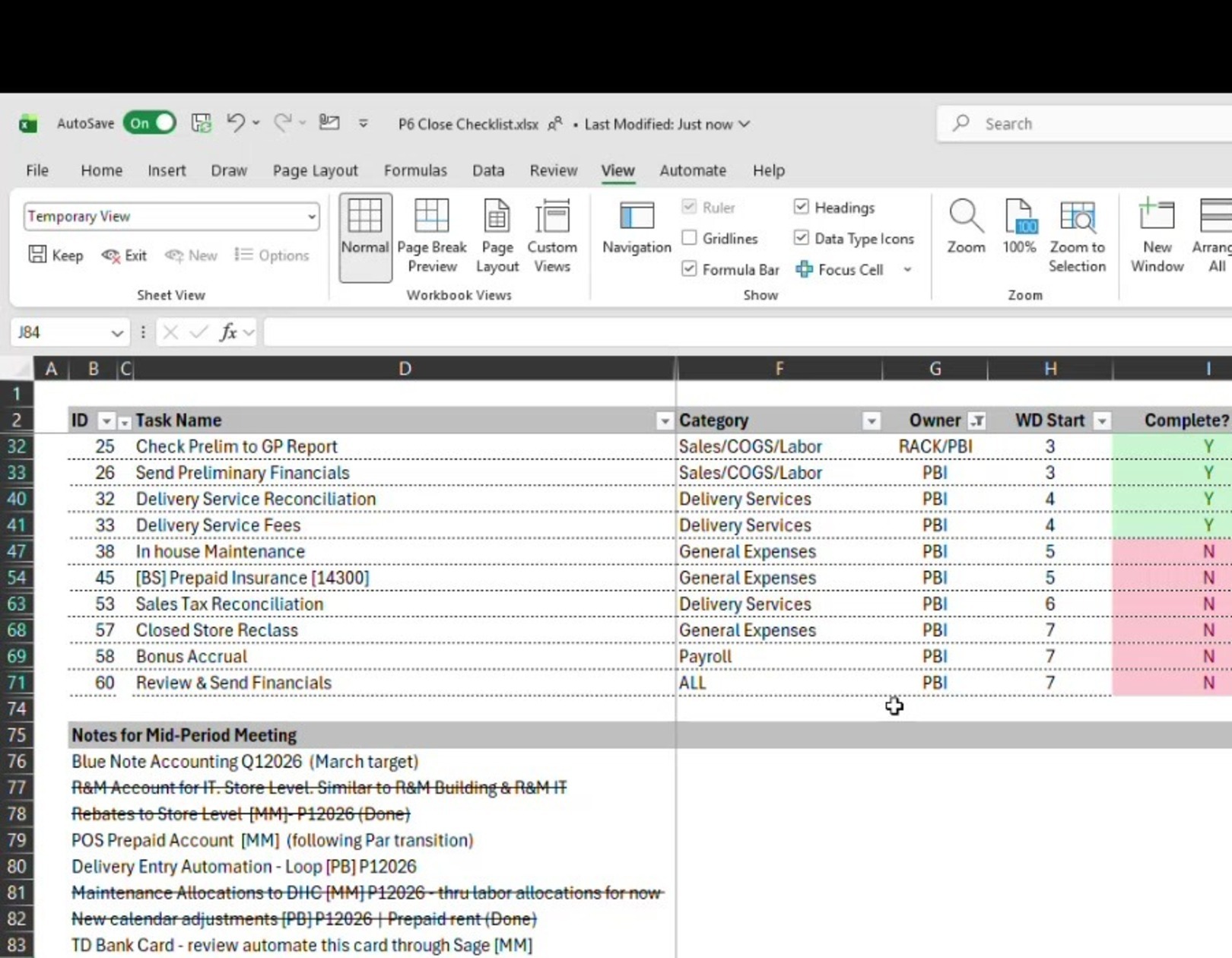
| 4 | Delivery Service Reconciliation | Delivery Services | PBI |
| 4 | Delivery Service Fees | Delivery Services | PBI |
| 5 | In-House Maintenance | General Expenses | PBI |
| 5 | [BS] Prepaid Insurance [14300] | General Expenses | PBI |
| 6 | Sales Tax Reconciliation | — | PBI |
| 7 | Closed Store Reclass | General Expenses | PBI |
| 7 | Bonus Accrual | Payroll | PBI |
| 7 | Review & Send Financials | ALL | PBI |
This is a partial capture — the source sheet was filtered/collapsed when recorded, so several task IDs in between are not shown. Treat it as representative of the shape and cadence of the checklist, not a complete task list. Open the live file for the full, current set.
"Check Prelim to GP Report" is jointly owned by the client (RACK) and PBI — one of the few tasks that isn't purely PBI-side.
"CAT Tax" refers to the Ohio Commercial Activity Tax accrual — distinct from sales tax (its own WD6 task) and from property tax.
"Notes for Mid-Period Meeting" — the running open-items list
Below the task table, the same checklist tab keeps a running list of open action items discussed at mid-period meetings, each tagged with initials and a target period.
This is a genuinely useful pattern to continue — it keeps longer-running process improvements from getting lost between closes.
| Item | Owner / target | Status |
|---|---|---|
| Blue Note Accounting | Q1 2026 (March target) | Open |
| R&M account for IT, at the store level — similar treatment to R&M Building & R&M IT | — | Open |
| Rebates to store level | [MM] · P12 2026 | Done |
| POS Prepaid Account (following the PAR transition) | [MM] | Open |
| Delivery entry automation — loop in | [PB] · P12 2026 | Open |
| Maintenance allocations to DHC — through labor allocations for now | [MM] · P12 2026 | Done |
| New calendar adjustments — prepaid rent | [PB] · P12 2026 | Done |
| TD Bank Card — review whether this card can be automated through Sage | [MM] | Open |
How to read this list: treat the bracketed initials as the owner of that item and the period reference as the target close by which it should be resolved. Confirm the current status of any unmarked item before assuming it's still open.
Close cadence observations
The close generally runs across roughly a week: prelims early in week one (WD –2 through WD1), then reconciliation work concentrated Thursday/Friday of week one and into the following Tuesday (WD5–WD7) — in-house maintenance and prepaid insurance on WD5, sales tax on WD6, and closed store reclass, bonus accrual, and Review & Send Financials all on WD7.
A holiday falling during close week has historically still been counted as a working day for scheduling purposes, even though the team acknowledged this makes an already tight week tighter. Flag it explicitly when planning around a holiday-adjacent close rather than assuming the calendar silently adjusts.
Mike has generally been flexible about a day of slippage when there's a legitimate reason, such as a holiday — based on the team's track record of otherwise staying on schedule.
As the team scales, the value of a more senior person on the account is expected to show up less in the early prelim work (WD –2 through WD2) and more from WD3 through WD7, where the bulk of reconciliation and review work is concentrated.
Role split at the time of the review
Confirm current ownership before relying on this table — responsibilities were actively being transitioned when this was recorded.
| Journal entry / task | Owner | Notes |
|---|---|---|
| Delivery service reconciliation & POS variance entries | Maureen (trained; Jessie also trained) | Jeff handled personally until roughly three months before the review. |
| In-house maintenance allocation | Jeff (historically) | Discussed as a candidate to transition — confirm current owner. |
| GL labor reclass (closed store / project labor) | Transitioning to Maureen | The format-drift watch-out applies. |
| Bonus accrual (restaurants + RCY) | Maureen | First solo close was the period following the review. Escalate account-level questions to Mike directly. |
| Prepaid expense reconciliation (14000 / 14600) | Jeff | The only adjustments made personally are for insurance endorsements/changes. |
| Sales tax reconciliation | Betsy | Handled outside the core RRS/RCY balance sheet team. |
Direction of travel
- The stated long-term model: Maureen (and Jessie as needed) become the primary preparers, with Jonah and John stepping into an oversight/reviewer role rather than preparing.
- Betsy is a resource rather than a day-to-day preparer — she has historical Rackson knowledge, including having previously booked in-house maintenance herself. Use her when a preparer hits a knowledge gap or a time crunch.
- A first solo close may reasonably run a day longer than steady state, and that is acceptable. The goal is a low-stress transition, not a rigid deadline on the very first attempt.
Related
- Close calendar — the two-week rhythm and the hard Wednesday prelim deadline
- Onboarding a new reviewer — the first-90-days path
- Key people — the full ownership and escalation matrix