
Prepaid insurance allocation review
The GL 14300 insurance allocation workbook — carrier blocks, unsynchronized policy periods, and the 85/15 entity split.
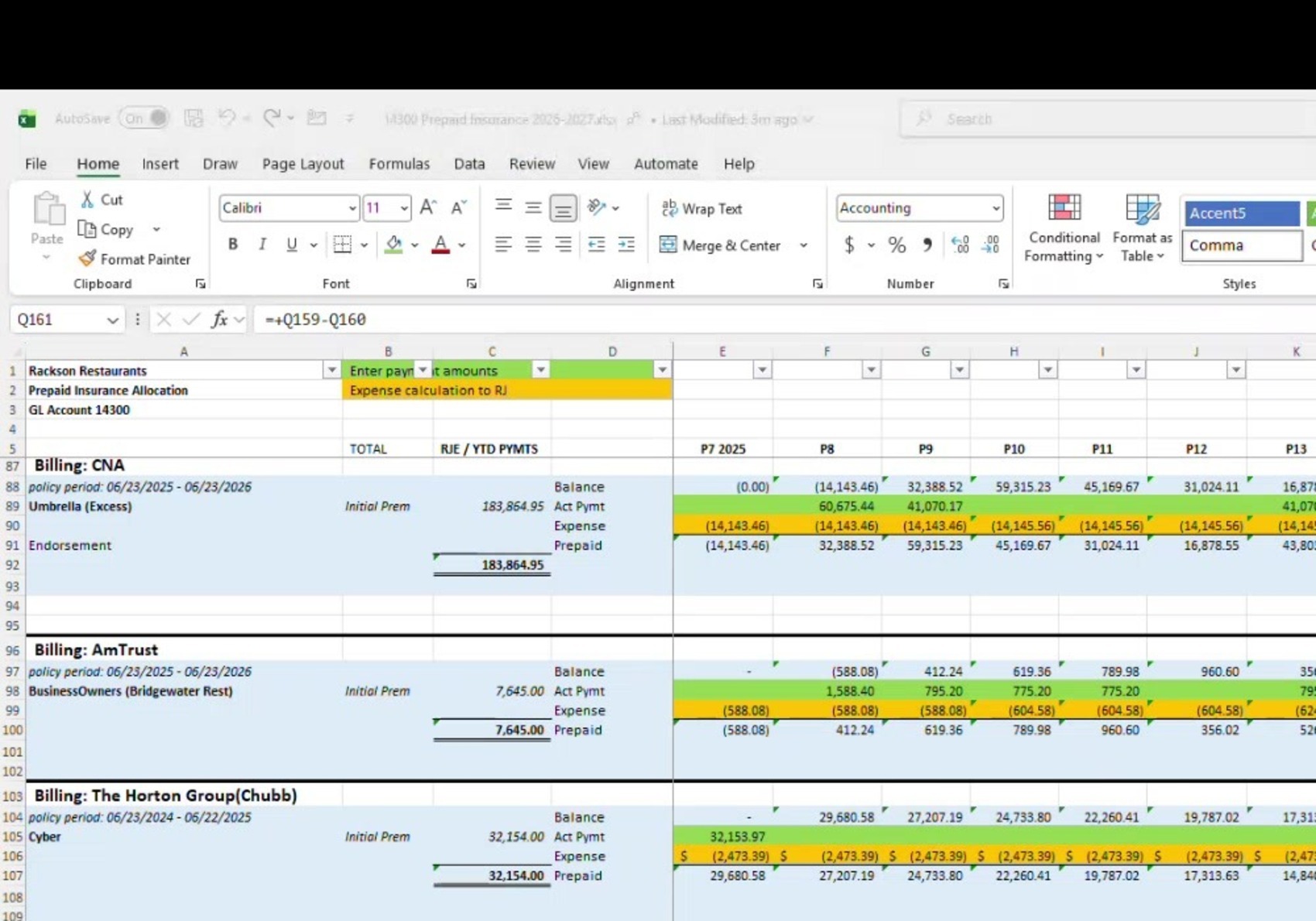
File: 14300 Prepaid Insurance 2026-2027.xlsx · Tab: Prepaid Insurance Allocation
Source: Rackson_RRS_RCY_Review_Process.docx section 42. This is a third, separate workbook from general prepaid (14000) and prepaid POS maintenance (14600) — see Prepaid expenses.
Layout
The workbook is organized by carrier/policy, each in its own labelled block (Billing: [Carrier Name]), followed by the specific policy line, the policy period, the initial premium, and then a four-row block per period:
| Row | Content |
|---|---|
| Balance | Opening prepaid balance for the period |
| Act[ual] Pymt | Payment made |
| Expense | Period expense recognized |
| Prepaid | Resulting prepaid balance |
Carriers in this workbook
| Carrier | Policy | Notes |
|---|---|---|
| CNA | Umbrella / Excess | — |
| AmTrust | BusinessOwners | Noted specifically for one entity in this file |
| The Horton Group | Chubb Cyber | Horton acts as broker |
Policy periods are not synchronized. Different policies run on different annual cycles — the CNA and AmTrust policies show a 06/23/2025–06/23/2026 period, while the Chubb Cyber policy through The Horton Group shows an older 06/23/2024–06/22/2025 period. Confirm each policy's actual current term before assuming they all renew together.
Formula style
Straightforward — a prior-balance-minus-current-payment roll-forward, e.g. =+Q159-Q160. This is an amortization roll, not a complex model. Most troubleshooting is a matter of finding which carrier's block has the wrong initial premium or policy date, not a broken formula.
PT&M — separate from insurance, same root idea
Two source documents from the client
The client (Mike) provides:
- A policy tracking sheet showing the total policy amount by policy type.
- A separate payment schedule showing how that total is billed out over time.
A distinct "Schedule A" document covers insurance policy detail specifically.
The 85/15 allocation
The general liability / property insurance premium is split 85% / 15% between the restaurant entity and a related theater-company entity. Confirm this allocation percentage hasn't changed before rolling the schedule forward — the split, not just the total premium, is what's being amortized.
Open item
The client rolled out new insurance/PT&M policies effective in March intended to reduce cost, but had not yet sent PBI the full breakdown of the new policy terms. The prior period's reconciliation was therefore not fully finished — PBI felt directionally good about the expense being reasonable but was waiting on the client's detailed policy/payment schedule to true it up completely.
Confirm current status before assuming this has been resolved. Tracked on Open items.
If the reconciliation won't tie, the fastest path to resolution is a direct call to the client contact rather than trying to reverse-engineer the new policy structure from GL activity alone.
Related
- Prepaid expenses review — the 14000 and 14600 workbooks, and the general prepaid review points
- RRS inventory and prepaids workpapers — the 14300 preparer steps, including the Workers Comp exclusion
- Open items