---
title: "Fixed Assets and Depreciation"
sidebarTitle: "Fixed assets"
description: "What qualifies as a fixed asset, the key terms, how depreciation and disposal are recorded, and the boundary between PBI's work and the client's CPA."
icon: "building"
---
> **For AI agents:** the complete documentation index is at [llms.txt](/llms.txt). Append `.md` to any page URL for its markdown version.
| Field | Value |
|---|---|
| **Owner** | Unassigned — needs an owner |
| **Department** | General Accounting |
| **Effective date** | Not set in source |
| **Scope** | Fixed asset concepts, key terminology, and the accounting for purchase, depreciation, and disposal. **Explicitly excludes** maintaining fixed asset schedules, determining useful life, and determining tax treatment — all of which belong to the client's CPA. |
| **Source** | `General Accounting/07 - Fixed Assets/Fixed Assets Concepts.docx` |
Fixed assets are long-term tangible resources a business owns and uses to generate revenue, and which are not intended for resale in the normal course of business. Think of them as the tools and infrastructure a company needs to run over the long term, rather than items it sells.
**Profit Builders does not maintain fixed asset schedules, determine the useful life of assets, or determine the best tax treatment of assets.** This work is done by the client's CPA. Do not make these determinations on a client's behalf.
## What qualifies
Fixed assets usually:
- Have a useful life of **more than one year**
- Are used in day-to-day operations
- Are recorded on the balance sheet under **property, plant and equipment (PP&E)**
- Lose value over time through depreciation — **except land, which is not depreciated**
- For tax purposes, have a minimum value of **$2,500**
Examples include buildings, land, machinery, vehicles, office furniture, and equipment.
The $2,500 threshold is why period-end review includes checking repair, maintenance, and equipment accounts for items over $2,500 that should have been capitalized. See [Financial analysis](/internal/sops/accounting/general/financial-analysis).
## Key terms
| Term | Meaning |
|---|---|
| **Cost** | The purchase price of the asset, plus any expenses to get it ready for use — shipping, installation, sales tax. |
| **Useful life** | The estimated period the asset is expected to be productive. **Determined by the client's CPA.** |
| **Accumulated depreciation** | A contra-asset account on the balance sheet tracking total depreciation charged against an asset since purchase. It reduces the asset's book value. |
| **Net book value** | The value of the asset on the balance sheet — cost less accumulated depreciation. |
| **Depreciation expense** | A non-cash operating expense on the income statement allocating the purchase price over the asset's useful life. Calculated as asset cost divided by the number of periods in the asset's life. |
| **Disposal** | Removing a long-term asset from the accounting records by selling, scrapping, or donating it — typically because it reached the end of its useful life, became obsolete, or became too costly to maintain. |
| **Gain/loss on sale of asset** | The difference between net book value and the proceeds received from disposal. |
## Why assets are capitalized rather than expensed
When a fixed asset is purchased, it is recorded on the balance sheet at cost — which can include installation, shipping, and sales tax.
Because fixed assets represent resources the company owns that provide **future** economic benefit, they should not be expensed in one period. Instead the cost is spread over the asset's useful life through depreciation, which matches the expense of the purchase to the revenue generated from using the asset.
Depreciation is calculated by dividing the asset cost by the number of periods in the asset's life.
## Worked example
A company buys equipment for $50,000 and records it on the balance sheet under PP&E. **No expense hits the income statement at that moment.**
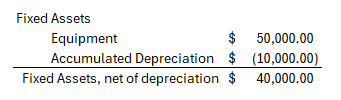
 Over time the asset is used up as it helps the company earn revenue. The equipment has a 5-year asset life, as determined by the CPA, so **$10,000 is recorded as depreciation expense on the income statement each year**.
On the balance sheet, the asset's value is reduced by accumulated depreciation.
Over time the asset is used up as it helps the company earn revenue. The equipment has a 5-year asset life, as determined by the CPA, so **$10,000 is recorded as depreciation expense on the income statement each year**.
On the balance sheet, the asset's value is reduced by accumulated depreciation.
 After one year the equipment's net book value is **$40,000** — $50,000 original cost less $10,000 accumulated depreciation.
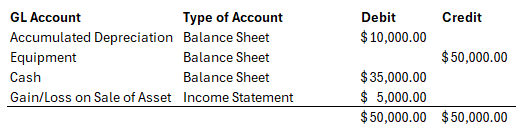
 After one year the company sells the equipment for $35,000. It removes the original cost from the balance sheet along with any accumulated depreciation.
The difference between the sale price and net book value ($40,000) appears as a **loss of $5,000** on the income statement.
After one year the company sells the equipment for $35,000. It removes the original cost from the balance sheet along with any accumulated depreciation.
The difference between the sale price and net book value ($40,000) appears as a **loss of $5,000** on the income statement.
 ## Accounting for a disposal
Four things happen on every disposal:
1. **Remove the asset's cost** — the original cost is removed from the books, typically by crediting the asset account.
2. **Remove accumulated depreciation** — the total depreciation recorded for the asset is removed from the accumulated depreciation account.
3. **Record proceeds from the sale** — any cash or other value received is recorded.
4. **Recognize gain or loss** — the difference between net book value and proceeds is recorded as a gain or loss on disposal.
## Related documents
- [Financial analysis](/internal/sops/accounting/general/financial-analysis) — the period-end check for expenses over $2,500 that should be capitalized
- `Book.xlsx` — see [Supporting materials](/internal/sops/accounting/supporting-materials)
The source library includes a `Fixed Assets PBI vs Client Responsibilities.docx`, but **the document contains only its title** — no content. Given PBI explicitly does not maintain fixed asset schedules, documenting this split is worth doing properly. See [PBI vs. client responsibilities](/internal/sops/accounting/responsibilities).
## Accounting for a disposal
Four things happen on every disposal:
1. **Remove the asset's cost** — the original cost is removed from the books, typically by crediting the asset account.
2. **Remove accumulated depreciation** — the total depreciation recorded for the asset is removed from the accumulated depreciation account.
3. **Record proceeds from the sale** — any cash or other value received is recorded.
4. **Recognize gain or loss** — the difference between net book value and proceeds is recorded as a gain or loss on disposal.
## Related documents
- [Financial analysis](/internal/sops/accounting/general/financial-analysis) — the period-end check for expenses over $2,500 that should be capitalized
- `Book.xlsx` — see [Supporting materials](/internal/sops/accounting/supporting-materials)
The source library includes a `Fixed Assets PBI vs Client Responsibilities.docx`, but **the document contains only its title** — no content. Given PBI explicitly does not maintain fixed asset schedules, documenting this split is worth doing properly. See [PBI vs. client responsibilities](/internal/sops/accounting/responsibilities).